The original telescope, a homemade 10-inch Newtonian reflector, was finally added during the spring of 1998, which put the observatory in working order. The observatory was dedicated on August 22, 1998.
The first campaign to upgrade the observatory began in the spring of 2000. The members of the Kalamazoo Astronomical Society (KAS) took advantage of the partial solar eclipse that occurred on Christmas Day of that year and purchased 1,000 pairs of eclipse glasses. Through sales of the eclipse shades and many generous donations, the KAS purchased a Meade 12-inch LX200 Schmidt-Cassegrain telescope a year after the campaign began and installed it in June 2001. Thousands of people viewed the wonders of the universe through the 12-inch for nearly 18 years.
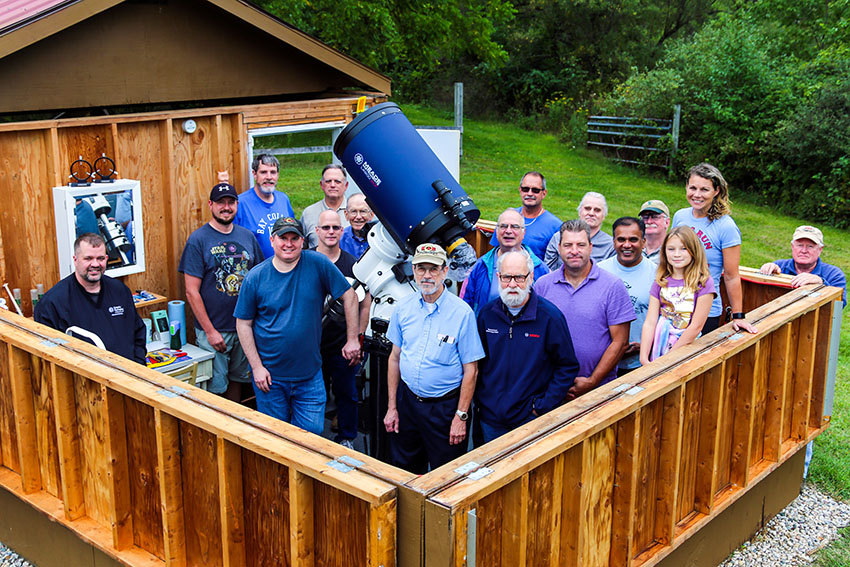
A second campaign to seriously upgrade Owl Observatory began in October 2016. In addition to upgrading to a larger aperture telescope and an ultra-sturdy mount, the roll-off roof was finally motorized. Like with the previous upgrade effort, eclipse shades were sold ahead of the 2017 Great American Eclipse, but this was only the start. Thanks to the generosity of KAS members, over $41,000 was raised. The main telescope and mount were installed in September 2019.
The observatory is located on the grounds of the Kalamazoo Nature Center, which is recognized as one of the nation's best nature centers. Since 1960, the Nature Center has been inspiring people to care about the environment by providing experiences that lead them to understand their connection to the natural world. It is located on 1,000 acres of rolling hills in southwest Michigan with a variety of habitats, including mature beech-maple forests, wetlands, and prairies. The KAS has been holding public sessions at the Nature Center for over three decades, and the observatory has increased our long partnership. The Nature Center offers reasonably dark skies, yet it is located only six miles north of downtown Kalamazoo.
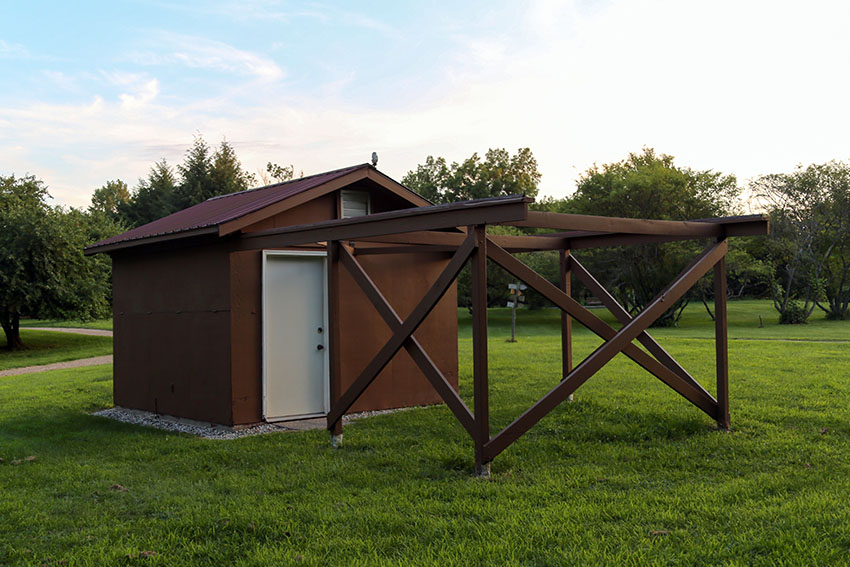
Owl Observatory is a 12' x 12' building with a roll-off roof that exposes the inside to the night sky. Roll-off-roof observatories have several advantages over domed observatories. Some of which include the following:
|
 |
To facilitate serious observing and imaging, the telescope is supported rigidly on a steel pier, which, in turn, is bolted to concrete pads sunk deep into the ground and physically isolated from the rest of the building to avoid vibration and the effects of wind. The telescope is equatorially mounted to provide accurate tracking of stars for astrophotography.
Public Observing Sessions are held at the observatory twice a month, from April to October. Schools and other similar groups will also have access to the facility. At other times, KAS members will be making use of the observatory for their observing and imaging programs. The KAS owes a sincere expression of gratitude to those members and many donors who stepped forward with cash donations and in-kind support to make this facility a reality.
Rules for Observatory Use
- Be a member of the KAS in good standing for at least three (3) months. This grace period may be waived at the discretion of the KAS Board.
- Have your dues paid in full for the current year.
- Have successfully read the Owl Observatory User's Guide (available upon request) and completed the observatory training.
- Have demonstrated competence in using the observatory telescope and proper opening and securing of the facility at a public or private activity after the training session.
- Any violation of these rules or of the Code of Conduct could result in the suspension of observing privileges.