
PlaneWave 20-inch f/6.8 CDK Telescope
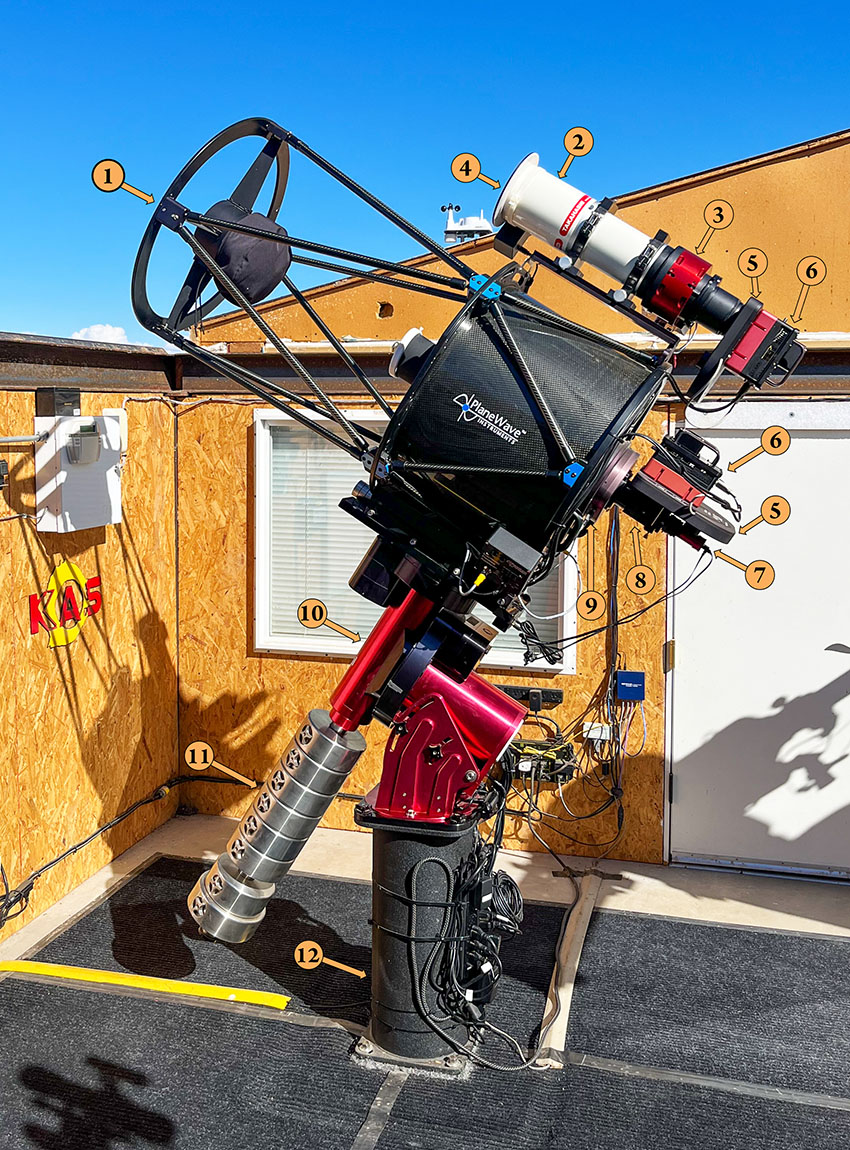
The PlaneWave Instruments CDK20 is a 20-inch (0.51-meter) Corrected Dall-Kirkham Astrograph telescope. The CDK consists of three components: an ellipsoidal primary mirror, a
spherical secondary mirror, and a lens group. All these components are optimized to work in concert in order to create superb pinpoint stars across the entire 52-mm image plane.
The CDK20 has a dual carbon-fiber truss design, with three cooling fans ejecting air from the back of the telescope. We ordered our CDK20 with a quartz mirror for its superior
thermal capabilities instead of the standard Pyrex model. The instrument weighs 140 pounds and has a focal length of 3,454 mm.

Takahashi FSQ-106EDX3 Apochromatic Refractor
The Takahashi FSQ-106EDX3 is a refracting telescope that utilizes a flat-field, advanced Petzval quadruplet design along with extra-low dispersion (ED) glass to provide exceptional
color correction in the ultraviolet, visible, and infrared wavelengths.

Moonlite NiteCrawler 2 Axis Worm Drive Rotating Focuser
In January 2023, we replaced the stock focuser of the Takahashi with a Moonlite NiteCrawler 2 focuser. This is a fully electronic focuser that uses fly-by-wire control technology
for very accurate positioning in both focus and rotation. Its 25-pound payload capacity enables remote automation of large, heavy imaging instruments such as ours, while its
extreme position accuracy repeats down to 0.26 microns. We have the WR35 model, which features 505,960 steps per revolution.

Optec’s Alnitak Flip-Flat & Flat-Man XL-2 Flat Field Screens
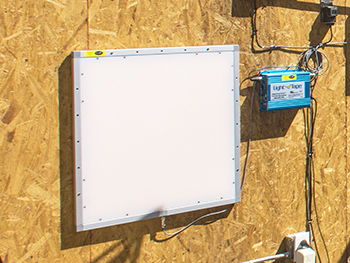
The Flip-Flat is a robotic lens cap and flat-field illumination source used for the Takahashi. The Flat-Man XL-2 is a stationary panel mounted on the north wall of Piishii
Observatory. We have a model that measures 24 inches square. Both the Flip-Flat and Flat-Man employ advanced electroluminescent lamp panel technology to provide a uniform source of
illumination for the production of high-quality flat field frames necessary for serious astro-imaging and photometric work. With the Flip-Flat and Flat-Man, on-demand flat fields
with uniformity errors less than 1% are now possible.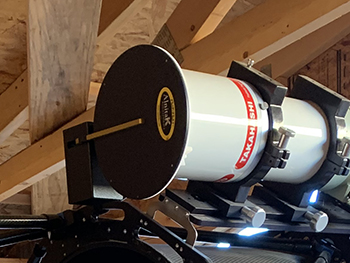

SBIG FW7-STX Filter Wheels (2)
The SBIG FW7-STX is a 7-position, 50mm square filter wheel for STX series cameras. Both filter wheels are equipped with a complete set of Astrodon filters designed specifically for
full-frame CCD cameras such as ours. These include 50-mm LRGB Gen2 E-Series Tru-Balance Filters, which include luminance, red, green, and blue filters. Each filter wheel also
includes a set of three Astrodon narrowband filters, each with 3 nm bandwidths for enhanced contrast of nebulae. Our narrowband filters are hydrogen-alpha (H-α), sulfur (SII), and
oxygen (OIII). Narrowband filters are unaffected by white light, so we can image even during a Full Moon!

SBIG STX-16803 Monochrome CCD Cameras (2)
Both our CDK20 and FSQ-106 telescopes use the SBIG STX-16803, a 16-megapixel camera utilizing Kodak’s KAF-16803 CCD. It is a full-frame camera with a sensor measuring almost 37mm
square. The STX uses an innovative pin-fin heat sink. This design is the most efficient for dissipating heat per given volume. The new heat sink is an optimized design for this
camera, using a large custom pin-fin heat sink mated directly to the hot side of the 2-stage thermoelectric cooler to achieve maximum heat dissipation with a single large fan. In
less than 5 minutes, the STX achieves a delta of -50º C using air cooling only. All this helps to greatly reduce noise in astronomical images.

ZWO ASI174MM Mini Autoguider
The ZWO ASI174MM Mini is a monochrome guiding camera utilizing Sony's IMX174 CMOS sensor. Its pixel array measures 1936 x 1216, giving us a field-of-view over five times that of our
previous autoguider. This camera has low read noise and high dynamic range.

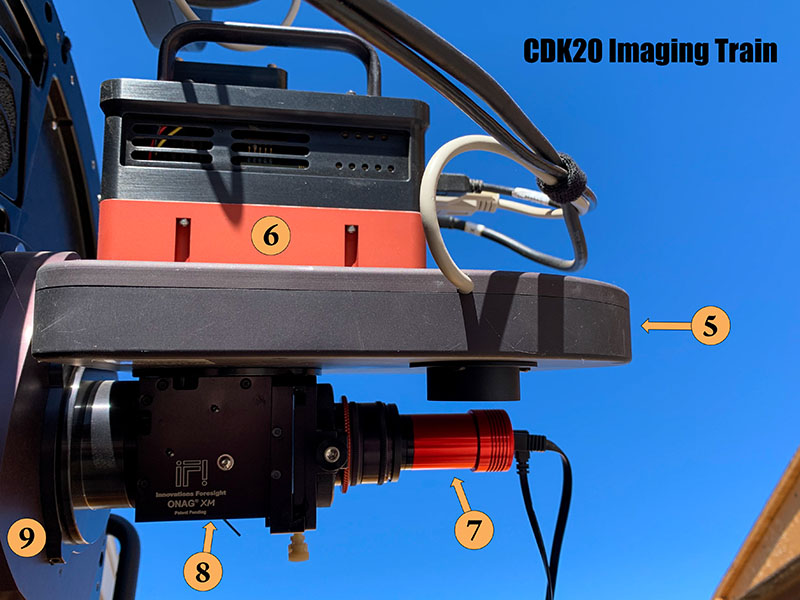
Innovations Foresight On-Axis Guider XM
The On-Axis Guider (ONAG) makes use of an advanced, inventive technology from Innovations Foresight. It features a special internal dichroic beam splitter, also known as a "cold
mirror." The cold mirror reflects visible light from the telescope to the imaging camera, passing the near-infrared (NIR) wavelength that is basically of no value for the purposes
of imaging, to the autoguider. Atmospheric seeing is better in the infrared, so this improves guiding reliability. Unlike an off-axis guider, an ONAG shares the same field-of-view
with the imaging camera. This allows a larger selection of guide stars and even makes possible the capability of using multiple guide stars.

Finger Lakes Instruments Atlas Digital Focuser
Our CDK20 imaging system includes a color filter wheel, on-axis guider, autoguider, and full-frame CCD camera. Together, they present a formidable group of equipment that must be
moved with micron accuracy and no image shift to achieve the finest results. The FLI Atlas Digital Focuser is up to the task! It features a miniature 105,000-step motor driven by a
micro-stepping controller that can achieve precise, critical focus with payloads up to 25 lbs.

Paramount ME II German Equatorial Mount
The workhorse of the KAS Remote Telescope is Software Bisque's Paramount ME II German equatorial mount. This robust mount has a total instrument capacity of 240 lbs, while only
weighing in at a moderate 84 lbs. The Paramount MEII's belt-driven motors provide nearly backlash-free movement. A maximum of 7 arcseconds of periodic error before correction
provides remarkable slewing accuracy, and clutch-less gears maintain T-Point's pointing accuracy to within 30 arcseconds. It is capable of tracking for up to 3 hours past the
meridian, eliminating the need for a "meridian flip" of the mount and telescope.

50-lb (1) & 30-lb (7) Stainless Steel Counterweights
Yes, it takes 260 pouns to balance the weight of the CDK20, FSQ-106, and the multiple accessories attached to each telescope. All our counterweights come from Software Bisque, the
same folks that manufacture the Paramount ME II.

Software Bisque Paramount Permanent Pier
Our Software Bisque permanent pier is designed specifically for the Paramount MEII. It is 24 inches tall and 14 inches in diameter. Its all-steel construction produces exceptional
stability and rigidity for all payloads up to 600 pounds. The steel pier is bolted to a concrete pier sunk deep into the ground and physically isolated from the rest of the
observatory to avoid vibration.

Piishii All-Sky Camera
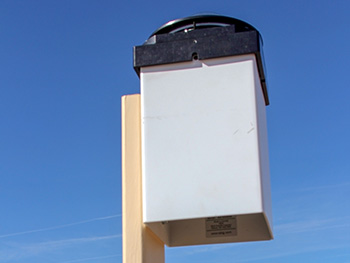
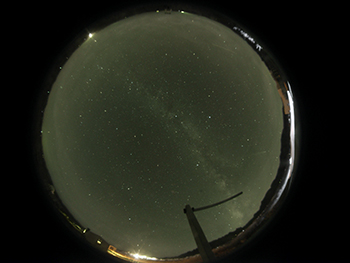
Our Piishii All-Sky Camera is used to monitor observatory weather conditions and enjoy the dark skies above Portal from southwest Michigan. It uses a ZWO ASI183MC Color Astronomy
camera coupled with a Fujinon 2.7mm f/1.8 C-Mount Fisheye Lens, all protected under an acrylic dome. This combination provides excellent image quality all the way to the horizon.
We use AllSkEye to operate the camera and upload the latest image to the internet. The current image from the all-sky camera can
be viewed here.